Revenue and cash are two different stories and one report
A founder who reads a weekly financial summary is trying to determine whether the situation is okay. Revenue alone is not enough. Revenue is what was billed. The bank records what actually arrived.
The two figures differ in the cases that matter. A strong billing month with slow collections looks healthy on one figure and is a problem on the other. A report that shows only billed revenue gives a false sense of security.
The third thing people omit is committed outflows. Cash on hand until next week's payroll does not reflect the real position.
Language matters as much as the figures. A summary written in accounting terms is ignored by the person who has to act. Plain language is not a simplification here. It is the version that gets delivered.
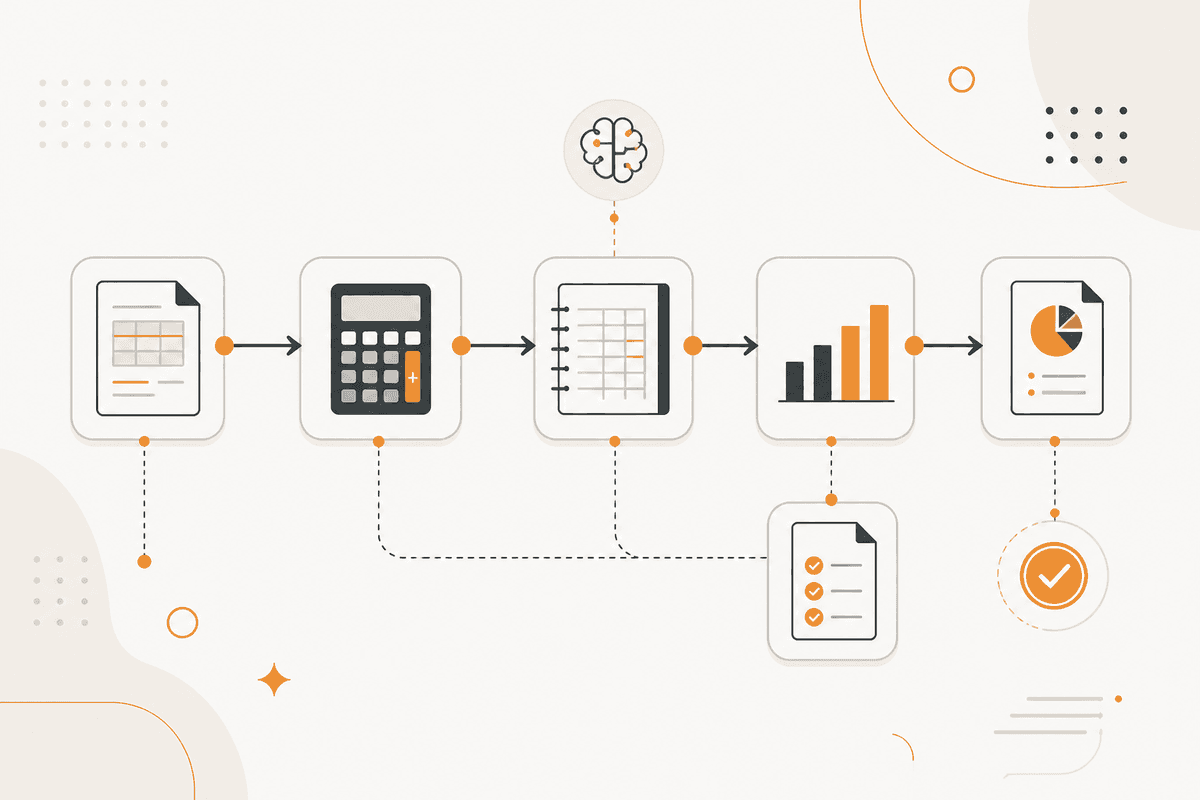
How the ActionFlow runs on the canvas
Figures come separately from the ledger and the bank. The flow is built to keep them apart. A Start Scheduled node opens the reporting week.
A PostgreSQL or Google Sheets node reads billed revenue and recorded expenses. An HTTP Request node pulls the bank position. Where it applies, a Stripe-style payments source or a Shopify node supplies collections.
A Merge node combines them. A Math node computes the week's movement, the billed-to-collected gap, and committed outflows for the coming period from the payables table.
A Date node determines which commitments belong to the next window, because a cash statement with no horizon cannot be acted on.
A Generate Object node returns a structure: revenue, collections, the gap, cash on hand, committed outflows, and the resulting position. The gap stays as its own field so it is not absorbed into the prose.
A Generate Text node writes the summary in plain language, with a length limit. A Slack node posts it. A Notion node archives it each week so the gap can be watched as a trend rather than read fresh every Monday.
Nodes this ActionFlow uses
- Start Scheduled: opens the reporting week.
- PostgreSQL (Data): reads billed revenue and recorded expenses. Google Sheets fits the same slot.
- HTTP Request (Util): pulls the bank position and collections.
- Merge (Control): assembles the ledger and bank views without conflating them.
- Math (Util): computes movement, the billed-to-collected gap, and committed outflows.
- Date (Util): identifies commitments falling inside the coming window.
- Generate Object (AI Core): keeps the gap as its own field so it survives into the summary.
- Slack (Communication): posts the summary. Notion archives it as a trend.
Frequently asked questions
Start building AI workflows
Create a free account, open a template or a blank canvas, and run your first ActionFlow.
Newsletter
Get product updates
New nodes, agents, and product notes. We send mail only when we have something worth opening.