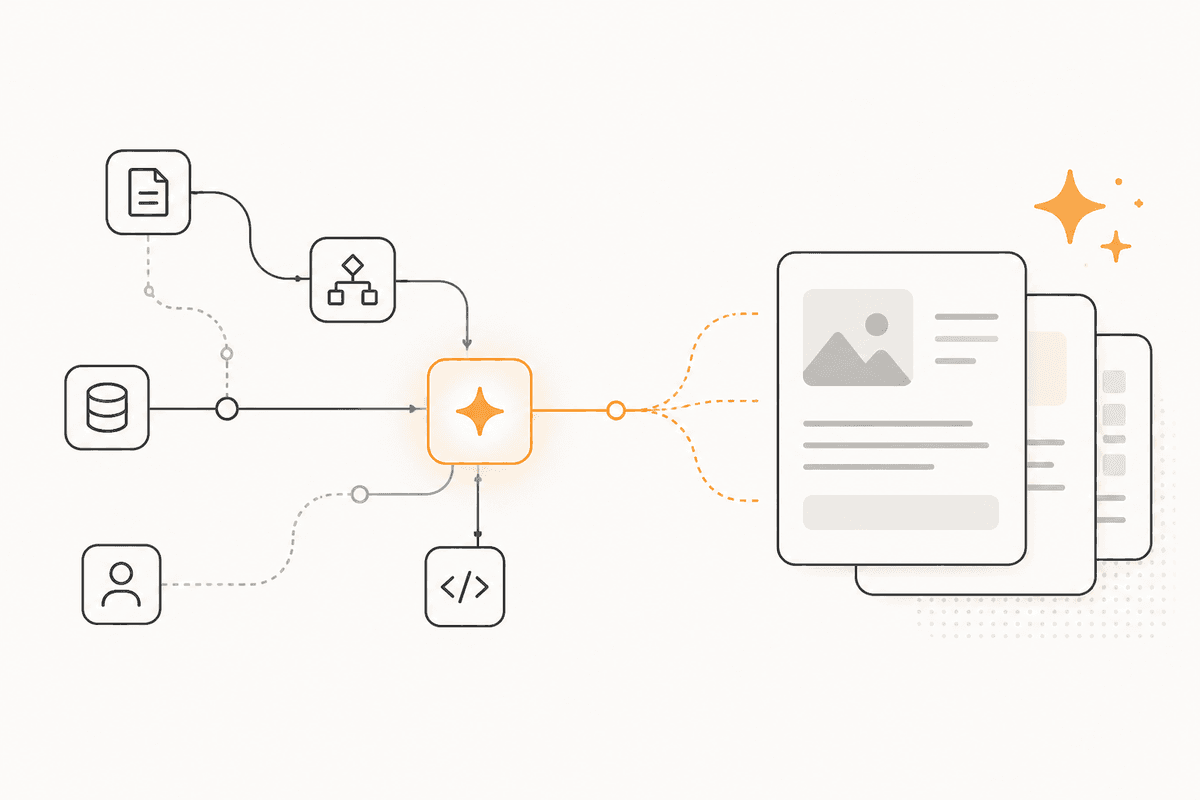
Not every source deserves five outputs
Fixed repurposing pipelines produce the same content from each input. A detailed technical article is condensed into a brief carousel, and a two-line announcement is expanded into a lengthy newsletter. The pipeline could not say 'this one is just a social post'.
That judgment is the only difference. When you read a source and decide what it can convey, how much real content it contains, who its actual audience is, and whether a visual would help, you are making a decision. Decisions are what distinguish an agent from a sequence of nodes.
The agent also decides how many outputs to produce, because three strong assets are better than seven when four are filler. Only someone who has read the source can tell which case this is.
If the sources actually differ, this judgment matters more. If they do not, it is only overhead.
How the agent is built in Agent Studio
The agent is set up once in Agent Studio and then reused. The system prompt sets the editorial standards. It defines what counts as enough substance for long-form output, names the formats your team actually publishes, and tells the model to return nothing rather than add filler.
Prompt skills include your voice guidelines, your channel rules, and the phrasings that you avoid. These are merged into the system prompt instead of being pasted into each conversation. When you update your voice guide, every later session uses the update.
The service and the model must support function calling, because the agent uses tools. Built-in tools handle generation. MCP connections attach anything else your stack exposes through the Model Context Protocol.
Each save increments configVersion. The runtime loads the latest config when it receives the next message. A change to the editorial standard takes effect immediately. You do not wait for a redeploy.
You can reach the agent in three ways: through Studio for testing, through the REST API or the JavaScript SDK on your own backend, or through the Agent Chat node in an ActionFlow. The Agent Chat path matters here, because a scheduled flow can pass each new published post to the agent and let it decide what to do. The judgment runs on a schedule. Nobody needs to open a chat window.
Because sessions last, a discussion about one campaign keeps its context across messages. You do not need to set up a chat server.
What this agent is built from
- System prompt: the editorial standard, including permission to produce nothing.
- Prompt skills: voice guidelines and channel rules, merged rather than repeated per conversation.
- Service and model: any provider that supports function calling, chosen for editorial judgment over speed.
- Built-in tools: generation attached in Studio.
- MCP connections: your own content systems, over encrypted remote connections.
- Agent Chat (Util): lets a scheduled ActionFlow automatically hand the agent each new source.
- When an ActionFlow is enough: If you always want the same four outputs from the same kind of source, build the workflow. The agent costs more only when the sources genuinely differ.
Frequently asked questions
Start building AI workflows
Create a free account, open a template or a blank canvas, and run your first ActionFlow.
Newsletter
Get product updates
New nodes, agents, and product notes. We send mail only when we have something worth opening.