A decision without an owner is a question
Meeting summaries are easy to produce and almost useless a week later. What a team needs is a short table: what was decided, who owns it, and when it is due. That table is buried inside conversation that never states it plainly.
The risk in extracting that table is not missing an item but inventing one. A model asked for owners and dates will supply them, and a confidently attributed decision nobody agreed to is worse than no summary.
The useful output has two halves. Items with a named owner and date go to the tracker. Items where the conversation never settled an owner go back to the team as open questions, because that is what they are.
The open-question list is the one that changes behavior. It is also the list a human summarizer quietly rounds off.
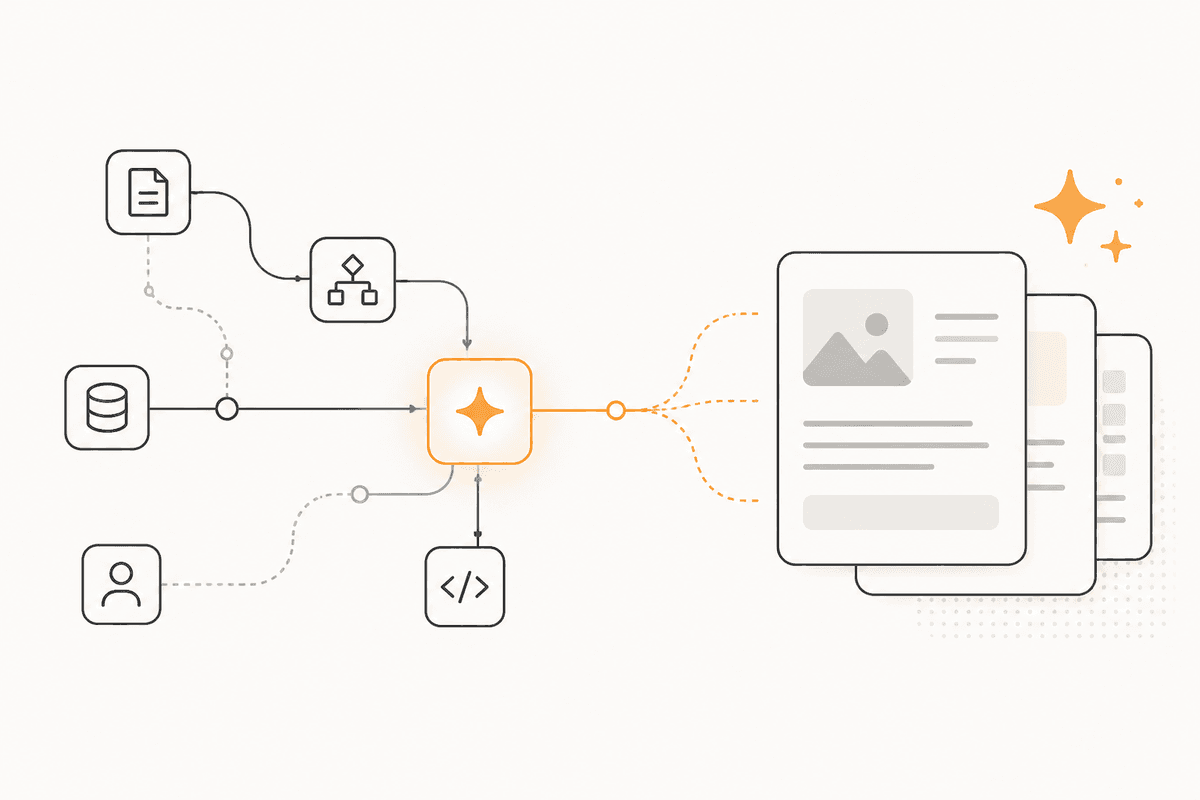
How the ActionFlow runs on the canvas
Two nodes handle intake: Document Upload for the file, then Transcribe Audio to convert it to text. When you have a transcript, Start receives it directly and both nodes drop out.
A Generate Object node runs a single extraction pass against a strict shape: decision, owner, date, and a confidence value. Every field must come from the transcript or be empty. Extracting into an object rather than a summary makes the next step possible.
A Validate node checks the structure and rejects rows with an empty owner or date. This is the node that stops invention from reaching the tracker.
A Filter node then splits the set. Complete rows continue to Notion or Linear as tracked items. Incomplete rows go to a Slack message addressed to the meeting owner, listing each decision without an accountable person. Including the attendee list in the extraction step as context materially improves attribution, because the model matches against known names rather than inferring roles from speech patterns. Where a name is ambiguous, the empty owner and the Slack message are the correct outcome.
Model choice matters here. Extraction against a long transcript rewards a model with a large context window, and the token count for that call is reported as a node output you can log alongside the run.
Nodes this ActionFlow uses
- Document Upload (Data): takes the recording or transcript file.
- Transcribe Audio (AI Core): converts the recording to text. Skipped when a transcript already exists.
- Generate Object (AI Core): extracts decision, owner, date, and confidence into a fixed structure.
- Validate (Data): rejects rows with an empty owner or date so nothing invented reaches the tracker.
- Filter (Data): splits complete rows from incomplete ones.
- Linear (Integration): receives complete items as tracked work. Jira, Monday, and Notion fit the same slot.
- Slack (Communication): sends the unattributed decisions back to the meeting owner as open questions.
Frequently asked questions
Start building AI workflows
Create a free account, open a template or a blank canvas, and run your first ActionFlow.
Newsletter
Get product updates
New nodes, agents, and product notes. We send mail only when we have something worth opening.