A reorder point set once is wrong by the following quarter
Reordering at a fixed threshold works when demand is flat but fails the moment it isn't. The threshold was based on last year's consumption. The supplier's lead time has drifted since then. The result is either a stockout during the week that mattered or capital sitting in a warehouse.
Getting it right means reading consumption as a rate with its variability rather than as an average. An item consumed steadily and an item consumed in unpredictable bursts need different cover at identical averages.
Lead time deserves the same treatment. A supplier with an average lead time of 12 days and occasional 30-day slips should be treated as a 30-day supplier for planning purposes.
The agent proposes quantity and timing with the reasoning visible. It places no order, because ordering commits money and usually a contract.
How the agent is built in Agent Studio
Demand history and supplier performance come from the systems the agent reads. Prompt skills capture what the numbers cannot express: seasonality you know about, planned promotions, and items being discontinued.
A second prompt skill records your service level per item category, because the cover a critical component needs and the cover a low-value consumable needs are different decisions.
The system prompt requires each proposal to show the consumption rate, variability, observed lead time, and the resulting cover, so that a buyer can disagree with one input rather than the conclusion.
It forbids proposing against a single average and requires a flag where history is too short to support a recommendation at all.
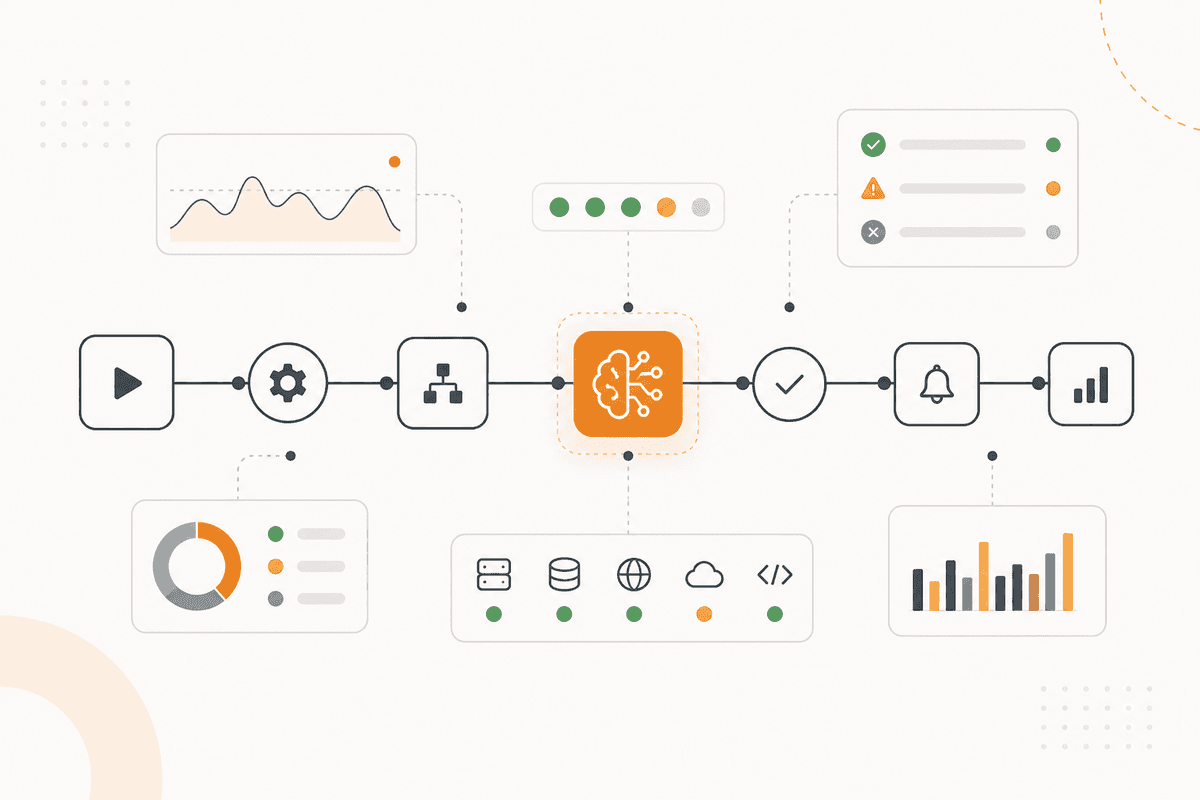
A PostgreSQL or MySQL node supplies consumption and receipt history, and a Math node computes the statistics before the Agent Chat node reasons about them.
Proposals go to Google Sheets as a buying list with their inputs, and a Slack node notifies the buyer when anything crosses your urgency threshold.
No purchase order is created or sent by the agent. A Human in the Loop node holds all proposals for the budget owner.
What this agent is built from
- Prompt skills: seasonality, planned promotions, and discontinuations that are not shown in the data.
- Prompt skills: your service level per item category.
- System prompt: consumption rate, variability, observed lead time, and resulting cover are all shown.
- System prompt: no proposal from a single average. Short history is flagged, not modeled.
- PostgreSQL (Data) with Math (Util): consumption and receipt history, and the statistics from it.
- Google Sheets (Integration): the buying list with its inputs visible.
- When an ActionFlow is enough: If items are stable and low-value, alerting when stock crosses a threshold is enough.
Frequently asked questions
Start building AI workflows
Create a free account, open a template or a blank canvas, and run your first ActionFlow.
Newsletter
Get product updates
New nodes, agents, and product notes. We send mail only when we have something worth opening.